Workshop for Cornwall Music Service Trust
The daily demands and pressures placed on music teachers can add up to a diminished connection with the inner fount of joy and fulfillment that drew us to music making in the first place. The effort involved is counter productive, and calm poise can often seem out of reach.
My intention with your workshop today is to revive that connection and explore what enlivens or dampens this precious part of ourselves by using aspects of body-mind awareness to illustrate and inform our choices and well-being.
To pull the plug on excessive effort and divert it into useful energy, poise and ease.
The pure ring of a Tibetan bowl becomes stifled when suffocated by a heavy scarf.
The story of the disastrous renovation of the Carnegie Hall is just such an example. Concrete poured under the floorboards of the stage destroyed the famous acoustic. All it took was the removal of the solid mass, to restore its former resonance.
The Alexander Technique could be seen as the skillful identification of where the “glue” is causing us to get stuck and the guidance to replace the glue with fluidity and ease.
Put even more simply, we could call it a “Quick re-think” as often, it is merely a change of thought that can bring about a powerful transformation.
“Living in a Body ” material devised by Robyn Avalon
When our muscles are attempting to perform the task of our bones, by grasping them tightly either out of alarm or misconception of the innate design of our bodies, the result is a similar loss of freedom and resonance.
We become easily fatigued, we can develop stress related injuries and our mood suffers.
The consequence of inaccurate perception of our innate design always leads to tension.
We explore the base of the index finger, palm side up and discover that the skin is not an accurate indication of where the joint is actually located.
By turning the hand over, palm down, the knuckle is seen to be almost an inch closer to the wrist than the crease in the palm.
Attempting to bend a bone at a falsely conceived joint requires unreasonable effort!
What you think is what you get.
There are many areas in the body that suffer from similar misunderstandings.
A major player in the body’s orchestra is the dynamic balance of the head atop the spine.
When asked to place a hand “on the bottom of your head in front” , unless you already know the answer, most people will place their hand under the chin.
We contrast the subsequent “chin-head ” with the more accurate “nose head”. Adopting the former radically reduces arm movements and the possibility of taking a deep breath.
Restoring the nose-head immediately releases arms and ribs.
A similar loss of mobility is experienced with the extremes of dog-tail and duck-tail which is especially relevant for musicians who spend long hours sitting.
Another area to explore is the “wing-fabric”.
Unlike the convention of clothes, where the arm joins the torso at the shoulder “sleeve”, the point of bone connection of the upper limb to the torso is the humble collar bone, where it contacts the breast bone at the front of the rib cage and thereby transmits weight via the ribs to the spine…. and from there through pelvis and legs to ground.
This has huge implications for taking diverting some of the muscular work away, leaving the arms freer to do all the delicate work of managing the instrument.
The muscular fabric of the “wing-structure” in the back extends from the base of the skull, all the way to the tail bone. It is also extensive in the front.
One of our group helps me to demonstrate the way the shoulder blade and collar bone between them, carry the shoulder joint to a wide range of potential free movement.
We again experience the loss of this freedom as soon as the chin-head and or dog-tail dominate and the ease with which this can be resolved with a thought…. the body is servant to the thought.
We just don’t always recognise our habitual thoughts and acquired beliefs!
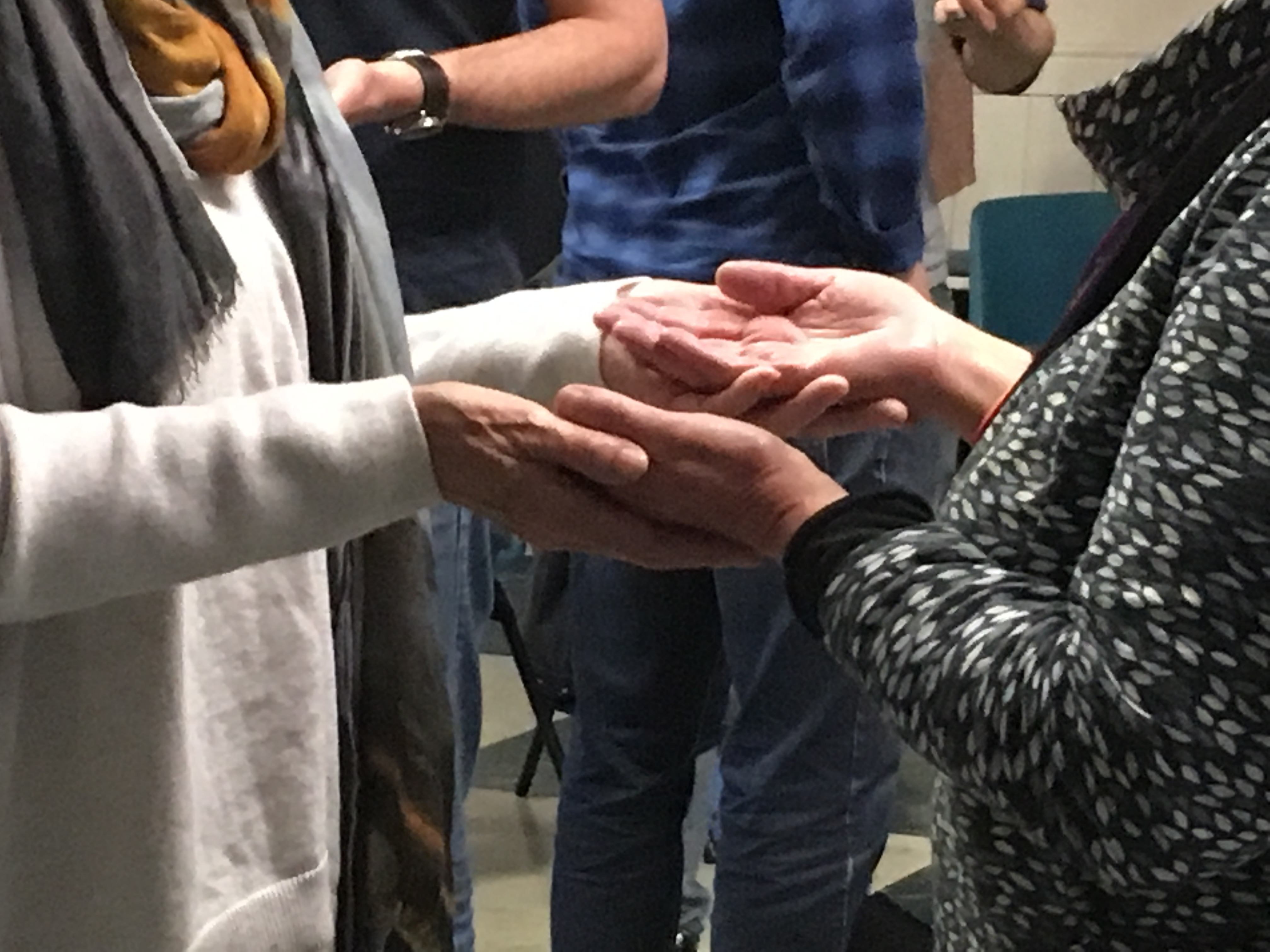
We make a metaphorical head-body pair with our hands as cradles… The lower cradle represents the curved surface of the first vertebra and the upper, the matching curve of the base of the skull.
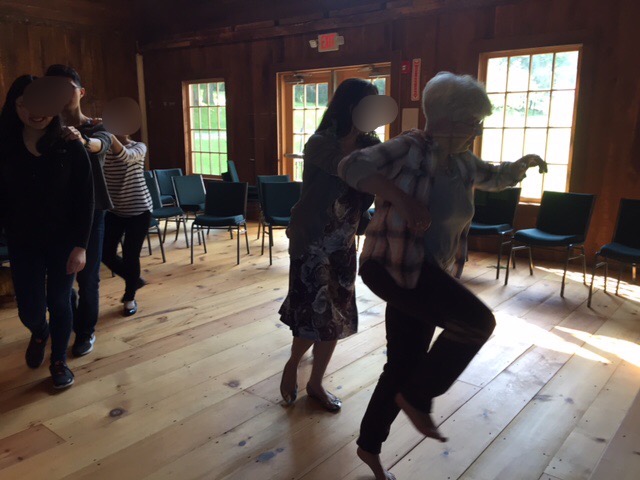
Head takes body for a walk.
Pushing down….. Very hard work
Pulling up…. No control
Resting comfortably…. Easy connection
We draw the connection between the effect of heavy or nervous mood, its effect on the head-neck balance and the resulting sabotaged coordination.
Inhibition
An Alexander jargon word that means a profound stop. Neutral gear, where we are neither in resistance, flight or anticipation, but at rest.
This pause can be our greatest ally in being a buffer zone between the prompt to activity and actually going into action.
It is the opportunity to briefly notice and refresh our poise. For the purposes of this workshop, to refresh the idea of nose-head, dinosaur tail, ease.
Lastly, we do a guided mediation called “the cycle” as developed by Mio Morales.
An etude in enquiry and attention to “where in my body am I easy right now”?
A short, deliberate and highly portable activity of thought and awareness that is available to practice at any moment… It’s a great prelude to instrumental practice. To getting in the car. Before entering a classroom. Unwinding at night.
It has contributed to the recovery of my thumbs and my ability to play the piano again.
A profound stillness settles in the room.
My thanks to all my teachers and to all of you for your generous attention.